
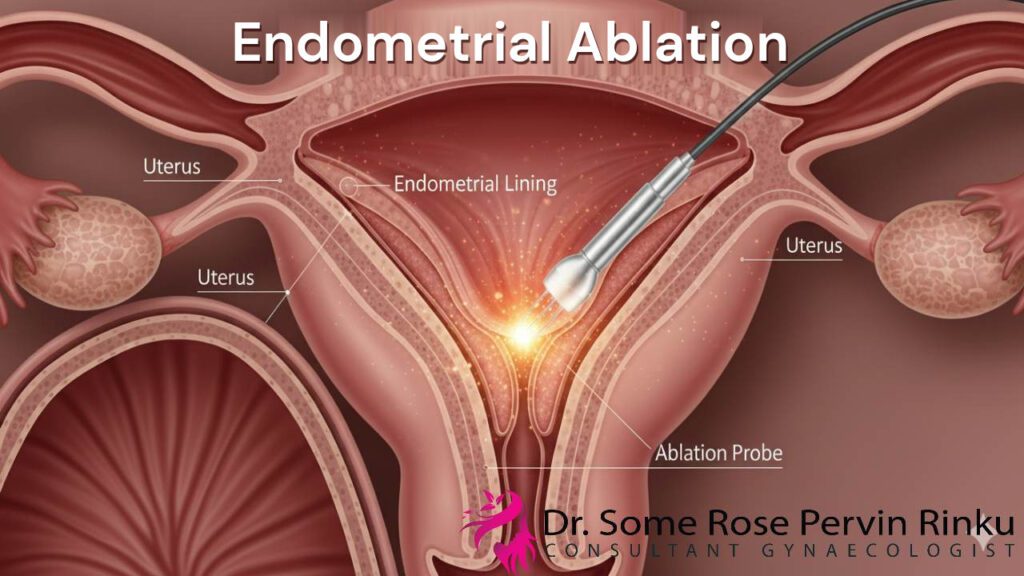
Endometrial Ablation is a minimally invasive procedure developed for women who suffer from menorrhagia (heavy menstrual bleeding) and it is this condition that impacts women’s lives each month. Hysteroscopic endometrial ablation is a safe, minimally invasive procedure that can help control or eliminate heavy menstrual bleeding when medication and other treatments are not an option.
Introduction
Menorrhagia – Characteristic Causes, Complications, and Treatment Excessive menstrual bleeding which is abnormally heavy is often termed menorrhagia and is suffered by thousands of women throughout the world causing disruption to life and often distress. For women who experience little relief from medication or other therapies, endometrial ablation presents an outpatient, minimally invasive option for reducing or eliminating abnormal bleeding and for avoiding more extensive surgery.
What is Endometrial Ablation?
Endometrial ablation eradicates or destroys the coating of the uterus to indulgence heavy menstrual bleeding. Though it is not a form of contraception, doctors endorse it only for women who no longer wish to conceive. This technique reduces bleeding more efficiently than tranexamic acid or NSAIDs, and in several cases, it can stop the bleeding completely.
Why Consider Endometrial Ablation?
Endometrial ablation may be the right choice for women who:
- Heavy Menstrual Bleeding that gets in the way of daily activities.
- Have not responded to hormonal or other treatments.
- Wants to avoid a hysterectomy.
- Prefer a minimally invasive treatment.
However, this procedure is unsuitable for women who:
- Are planning future pregnancies.
- Have uterine cancer or other major uterine abnormalities.
- Have untreated pelvic infections.
Types of Endometrial Ablation Techniques
There are various approaches, depending on the condition. The best method for you will be advised by your doctor to meet your specific requirements.
- Thermal Balloon Therapy: A hot fluid-filled balloon destroys the lining of the uterus.
- Radiofrequency Ablation: Radiofrequency waves destroy endometrial tissue.
- Cryoablation: The uterine lining is destroyed by being frozen.
- Microwave Ablation: Tissue is destroyed with heat generated by microwaves.
- Hydrothermal Ablation: Liquid heated to destroy the lining.
What to Expect During the Procedure
This usually is done in a doctor’s office or in a surgery center, while the person is under either local or general anesthesia.
- Preparation: The cervix is easily dilated.
- Procedure: A uterine manipulator is inserted and the appropriate method is performed.
- Monitoring: You’ll be monitored for a short time after the procedure before being sent on your way.
The procedure typically requires less than 30 minutes and most women go home the same day.
Benefits of Endometrial Ablation
This process is advantageously provided in multiple ways:
- Less invasive with less recovery time.
- The ability to bypass a major surgery, such as hysterectomy.
- Marked decrease or absence of menstrual bleeding.
- Improved quality of life.
- Safety and efficacy for heavy menstruation has been established.
Risks and Side Effects
Endometrial ablation is usually safe, but there are some potential risks:
- Temporary cramping and discomfort.
- Spotting or light vaginal discharge.
- Rare cases of infection.
- Very uncommon but potential injury to adjacent structures.
Important: Pregnancy after an ablation is harmful, so good contraception is crucial.
Recovery and Aftercare
Afterwards, women will typically be back to regular activities in 1-2 days. Occasional light cramps or bleeding happens, but goes away fast. It is important to check in with your gynecologist at regular intervals to track the progress and make any necessary modifications, if any.
When to Consult a Specialist
It’s time to see a gynecologist if you:
- Have heavy and/or long periods.
- Have had no relief with medication.
- Want a long-lasting alternative to the detriment of a surgical operation..
Final Thoughts
Endometrial ablation is a safe and effective option for managing disruptive heavy periods. If you’re considering treatment options, consulting a gynecologist is the first step to determining if this procedure suits your needs.
📅 Book an appointment with Dr. Some Rose Pervin (Rinku) for expert advice and advanced care in Rose Medical Center or Popular Diagnostic Center, Rajshahi.
Frequently Asked Questions
Can I get pregnant after endometrial ablation?
Conception is possible however it’s dangerous, and definitely not something doctors recommend. Permanent contraception is strongly advised.
Will my periods stop completely?
Some women stop having periods altogether, others experience a significant decrease in bleeding.
Is endometrial ablation available in Rajshahi, Bangladesh?
Dr. Some Rose Pervin (Rinku) provides the latest techniques for endometrial ablation at Rose Medical Center and Popular Diagnostic Center of Rajshahi.