
How much time has it been?If you have been wrestling with chronic pelvic pain for months without an answer, you are not alone. Millions of women suffer from persistent pelvic pain that is disabling and disruptive to their lives, relationships, and their sense of well-being. You’ve probably had many tests, multiple treatments, and still you have no idea what is going on with you or how to get better.
When things like ultrasounds and CT scans don’t find the root of your discomfort. It can really feel like a letdown. The good news is that laparoscopy, a minimally invasive surgical procedure, provides both hope and answers. This cutting-edge approach enables doctors to see your pelvic organs directly and often treat the problem at the same time.
In this guide, we’re going to unpack how laparoscopy functions, what kinds of conditions it can diagnose and treat and if it’s possible that it contains the solution to your problems. You’ll discover what the procedure involves, what to expect during recovery and how this long searched for solution could be your long hoped for relief from your pelvic pain.
What is Chronic Pelvic Pain?
Chronic Pelvic Pain Chronic pelvic pain is described as ongoing pain in the area below your belly button for six months or more. It can be anything from a dull ache to sharp, stabbing pain, which may worsen during some activities, such as exercise, intercourse or even sitting down for a prolonged period.
The complexity of chronic pelvic pain is the problem. Your pain could be caused by a number of things, and in a lot of instances, multiple factors coalesce to cause your symptoms. COMMON CAUSES AND DIAGNOSIS WHICH CAN BE SUSPECTED/CONFIRMED THROUGH LAPAROSCOPY:
- Endometriosis: Tissue that’s like the lining of your uterus grows outside your womb
- Fibroids: Benign growths on or in the uterus
- Ovarian cysts: Collection of fluid that form within the ovaries
- Adhesions: Bands of scar tissue that cause organs to stick together in ways that they shouldn’t
- Pelvic inflammatory disease (PID): an infection of the reproductive organs
What makes chronic pelvic pain particularly vexing is that routine imaging tests do not always identify the source. You may have normal ultrasound or MRI findings and still be in pain.” This is the gap in which distress & despair often hatch as you keep looking for answers.
How Can Laparoscopy Help?
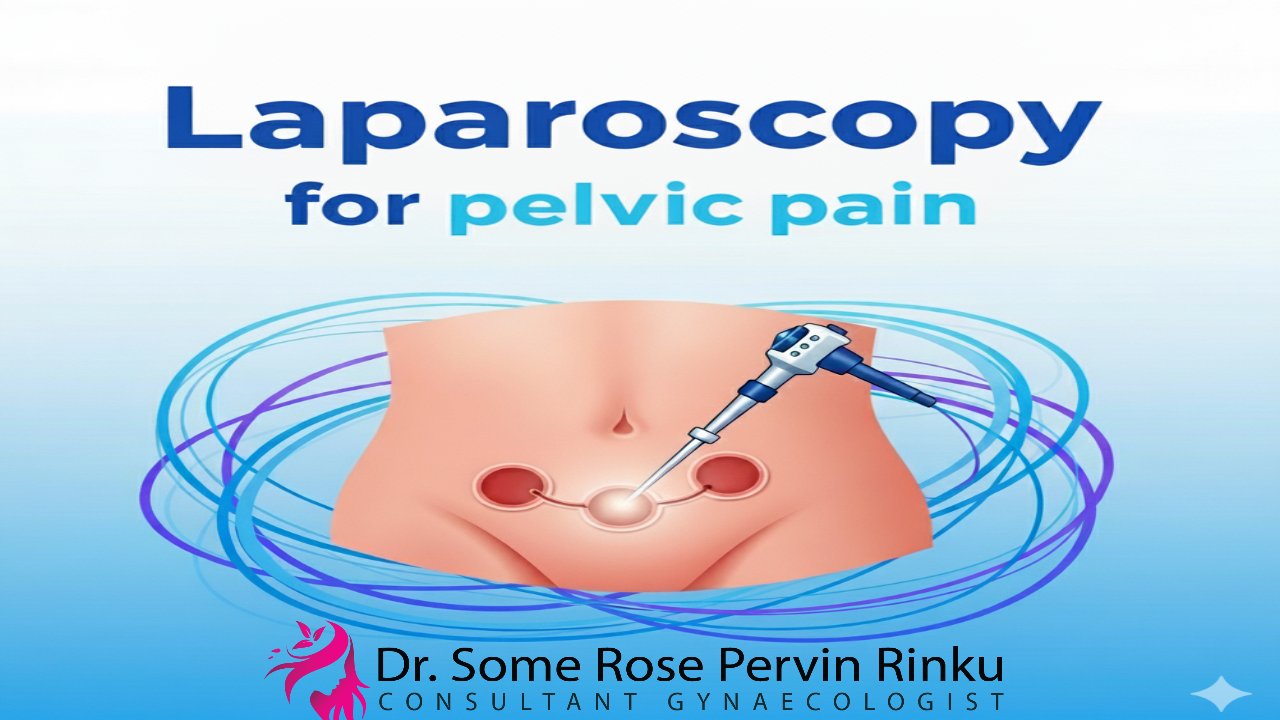
Laparoscopy Your doctor may be able to visually check your pelvic area by laparoscopy, a minimally invasive surgical procedure that involves making small incisions into which a laparoscope, a tiny camera, is inserted. In the course of this procedure, your surgeon makes several small incisions, usually no more than half an inch long, in your abdomen, and inserts the camera and other instruments to do the necessary work.
There are two great things about this method, which make it very useful in chronic pelvic pain:
Direct Visualization and Accurate Diagnosis
External imaging tests provide only indirect images of your organs, but when your doctor looks through the laparoscope, they see things in your pelvis at the very moment they’re occurring. The high-definition combination of camera and lenses displays high-resolution images of your uterus, ovaries, fallopian tubes and other adjacent structures. This real time visualization can show you conditions that you wouldn’t be able to see on other tests and most importantly is the answer you have been looking for!
Immediate Treatment During the Same Procedure
One of the biggest benefits of laparoscopy is “see and treat”: the surgeon can directly view the problem and treat it during the same procedure. In the event that your surgeon finds an issue during the diagnostic process, many times they are able to fix it on the spot through the insertion of specialized tools through other small incisions. This means that you may be diagnosed and treated in one procedure, without having to undergo surgeries at a later date.
Laparoscopic surgery is also precise so that treatment can be focused. Your surgeon is able to then clear the endometrial implants, drain the cysts, cut adhesions or do whatever process that is vital with minimum tissue damage.
The Laparoscopy Procedure: What to Expect
Knowing what to expect during laparoscopy can help allay your fears and allow you to prepare yourself for the procedure. Here’s a comprehensive look at the process:
Before the Surgery
Preparing for the procedure You will usually start preparing for the test a few days before your procedure. You’ll get detailed directions to follow on fasting, typically no food or drink after midnight the night before surgery. You’ll also have a pre-operative appointment in which your surgical team goes over your medical history and details of the surgery, along with any questions.
Just be sure to line up a driver to take you home after the procedure; you’ll be put under general anesthesia and won’t be able to travel on your own for at least 24 hours. Think about setting some things up in your house to help make recovery easier, such as soft pillows and easy to prepare meals.
During the Surgery
Laparoscopy is done under general anesthesia, which means that you’ll be in deep sleep during the procedure. Your doctor will start by making a small incision near your belly button and inserting a long, thin tube to is put inside your body through the same incision to pump carbon dioxide gas into your abdomen. This gas creates a space between your organs, so the surgeon has a clear view and the ability to work safely.
Second, the laparoscope is placed in the first incision. Tiny cuts may be made to surgically put in instruments if treatment is necessary. The whole process usually takes 30 minutes to a couple of hours, depending on what your surgeon finds and whether they treat anything.
After the Surgery
The majority of laparoscopic surgeries are done on an outpatient basis, so you can leave the same day. You’ll spend time in recovery as the anesthesia starts to wear off, and your care team will track vital signs and your level of comfort.
The recovery is much quicker than with old fashioned open surgery. You may experience some bloating and mild discomfort for a few days while your body absorbs the carbon dioxide gas that was used during the procedure. In addition, shoulder pain due to retained gas may occur and generally improves after 24-48 hours.
For most women, it is no more than about a week to return to normal activities, although heavy lifting and strenuous exercise should be avoided for roughly 2 weeks. Based on what was found and treated during your surgery, your surgeon will give you instructions for your recovery.
What Conditions Can Laparoscopy Treat for Pelvic Pain Relief?
Laparoscopy works well for diagnosing and managing many of the following conditions that may be responsible for chronic pelvic pain:
Endometriosis
Endometriosis affects 10% of women in their reproductive years and is among the most common causes of chronic pelvic pain. During laparoscopy, your surgeon can see endometrial implants — tissue that looks like your uterine lining that has pushed through the lining of the uterus. These can be removed or destroyed through heat (ablation), which often leads to a large reduction of pain in most women.
Sarah, 32, said she suffered three years of excruciating pelvic pain before laparoscopy uncovered widespread endometriosis. “I was told for years that my pain was normal, so to finally have a diagnosis and treatment was life-altering,” she says. “Within a few months of my laparoscopic surgery, I was able to exercise without pain and was no longer scheduling my life around my pain schedules.
Ovarian Cysts
Although many ovarian cysts go away on their own, others don’t disappear, irritate the uterus and trigger more pain. With laparoscopic surgery, your surgeon can remove cysts causing trouble, while leaving your healthy ovarian tissue intact. This accuracy is especially critical for women who want to preserve their fertility.
Fibroids
There are indications for the removal of certain type of uterine fibroids. Under a laparoscopic technique called laparoscopic myomectomy ( inadequate uterine fundal invasion,submucosal lie and endocavitary position). Advantages of this method include preference for the fibroids that are outside the uterus (subserosal fibroids or pedunculated fibroids).
Adhesions and Scar Tissue
Surgeries, infections or inflammatory conditions can lead to adhesions — bands of scar tissue that abnormally bind organs together. These adhesions can lead to organs pulling on one another, causing pain and, in some cases, interfering with organ function. Dissecting fibrous bands is called laparoscopic adhesiolysis, which may restore the normal anatomy and alleviate pain.
Benefits and Risks of Laparoscopy
As with any surgery, laparoscopy has both benefits and risks you need to know about as you make your decision.
Benefits of Laparoscopy
The minimally invasive nature of laparoscopy offers several significant advantages:
- Reduced size incisions: Several small cuts instead of a single large cut means less tissue damage and faster recovery.
- Less pain: Reduced tissue damage usually leads to reduced pain after surgery
- Faster recovery time: Most patients can get back to their usual activities in a week
- Lower risk of infection: Fewer and smaller incisions make the risk of wound-related complications smaller
- Improved cosmetic appearance: Very small scars are hardly noticeable once they have healed
- Best diagnostic accuracy: You’ll get a clear answer as to what’s causing your pain directly through visual a direct mosquito bite.
- Treatment on the day: Diagnosis and treatment is frequently achievable in a single visit
Potential Risks
Although laparoscopy is a very safe procedure, every surgery has some risks:
- Infection: Infection is very uncommon, however all surgical sites have potential to become infected
- Bleeding: This is rare but can happen, excessive bleeding during or after operation.
- Injury to other parts of your body: In extremely rare cases, other nearby organs, such as your bladder or your bowels, can be damaged by accident
- Anesthesia reactions: General anesthesia can cause adverse reactions in some individuals
- Blood clots: Patients are at higher risk of clotting with long periods of immobilization c. This is unlikely to occur with outpatient procedures.
You should consider these risks in consultation with your surgeon. And consider how your health and other risk factors may impact the level of risk for you. The odds of accepting any kind of risk are clearly going to be far outweighed by the relief. Most women will welcome in having a true diagnosis — and finally a course of treatment.
Is Laparoscopy Right for You?
Laparoscopy may be suggested if you:
- Experience chronic pelvic pain (pain for longer than six months)
- Not relieved by conservative treatment
- Inconclusive imaging test results
- Have signs or symptoms such as painful periods or pain during sex, for example, that suggest endometriosis
- Suspected Ovarian Cysts that are not resolving
- Require a certain diagnosis to make decisions about how to use treatment in the future
When deciding whether to recommend laparoscopy. Your doctor will take into account your particular symptoms. Medical history and any treatments you’ve had before.
Conclusion
Laparoscopy is a great answer for women who deal with chronic pelvic pain and get no answers. “We’re able to hone in and accurately diagnose and treat at the same time. Sometimes taking years of pain and discomfort away from patients.” Because it offers a clear view of your pelvic organs. Laparoscopy often can provide answers to medical problems that have been menstrual mysteries.
Benefits include smaller incisions, quicker recovery, and, potentially, same-day treatment. It is an appealing alternative for women looking to relieve their pelvic pain. With any surgery there are some risks, but the safety of laparoscopy. And the high success rate make it a very useful weapon in the battle against chronic pelvic pain.
If you’ve had enough unexplained pelvic pain that is negatively impacting your quality of life, listen to this: You don’t have to suffer in silence. Also consult with a gynecologist or laparoscopic surgeon. Who is experienced with the technique to determine if this approach could be suitable for you. This action may be the first step in your path toward the pain relief and answers that you deserve.
For more on how to deal with pelvic pain and what to do to get relief. Log on to the ACOG (American College of Obstetricians and Gynecologists) website information about: How to manage pain in your pelvis Sources: (American College of Obstetricians and Gynecologists) adapted from, acog. org, where you will find patient-centered resources and advice on locating specialists in your area.



